

The AI Revolution in MICE: Moving from Social Networking to the Era of Recommendation Feeds and Agentic Search

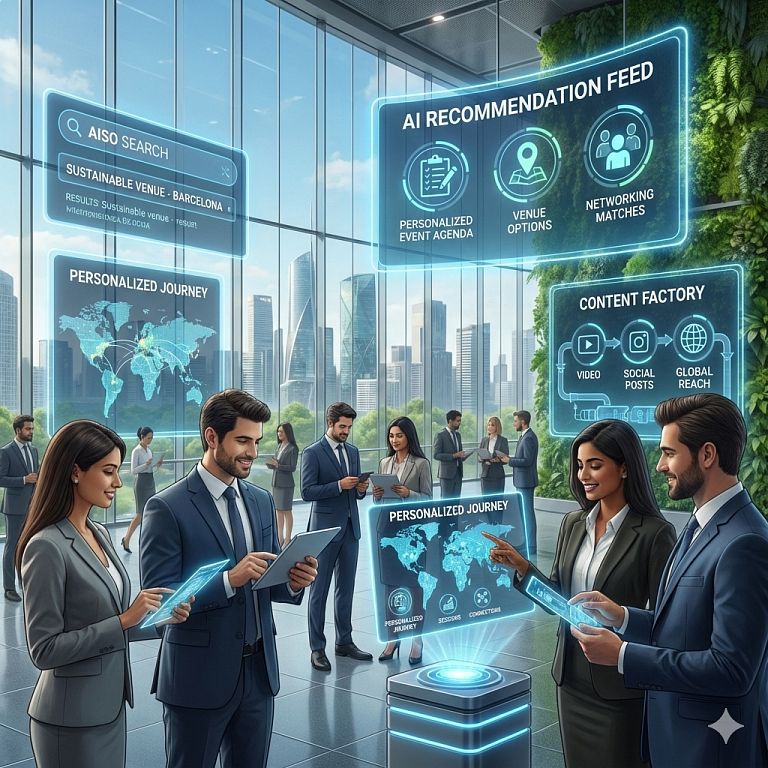
The Business Travel and MICE landscape is witnessing its most significant shift since the dawn of the internet. As traditional marketing funnels lose their edge, Artificial Intelligence is rewriting the rules of engagement. From how planners discover venues to how delegates experience content, we are moving beyond "who you follow" to "what the algorithm knows you need."
The Death of Social Media as We Knew It
Global visionary Gary Vee recently made a bold claim: "Social media is dead; the era of AI-based recommendation feeds is here." For the MICE industry, this is a game-changer.
In the past, your reach was limited by your follower count. Today, platforms like LinkedIn and YouTube use AI to analyze the quality and relevance of your content, pushing it directly to those who need it—whether they follow you or not. For a MICE professional, this means a high-quality video of a personalized incentive tour or a 3D venue showcase can go viral among corporate travel buyers and event organizers purely based on its merit. Content is no longer just "social"; it is "intelligent."
Search 2.0: From Google to AI Agents
The way clients find your services is changing. Instead of browsing pages of search results, decision-makers are now asking ChatGPT or Perplexity: *"Find me a sustainable venue in Barcelona for a 300-person tech summit with available dates in September."*
As AI agents gain the ability to browse the live web, a new discipline is emerging: AEO (Agentic Engine Optimization). To stay competitive, MICE brands must optimize their digital footprint so that AI agents recognize and recommend them as the top-tier choice for global RFPs.
Proven Impact: Efficiency and Engagement
AI is no longer a "future" concept; it is already delivering measurable ROI across the globe:
* 25% Higher Engagement: At major tech events, platforms like *EventCollab* use AI to curate personalized journeys for attendees, matching them with the sessions and networking opportunities that maximize their ROI.
* Marketing Automation: Industry leaders use tools like *CventIQ* for predictive lead analytics. Instead of manually sorting through RFPs, AI ranks them by conversion probability, allowing sales teams to focus on the highest-value opportunities.
* Dynamic Intelligence: Global chains like *Marriott* leverage AI for dynamic pricing and smart itinerary recommendations, reportedly saving corporate planners up to 60% of their research time.
The "Content Factory": Scaling Without the Overhead
For a modern MICE brand, staying visible across global markets is a massive undertaking. The "Content Factory" model uses AI to automate this presence:
1. Trend Analysis: Specialized AI tools monitor global exhibition trends (IMEX, IBTM) to suggest high-impact topics for your brand
2. Multi-Channel Distribution: A single event recap can be transformed into a LinkedIn article, a series of YouTube Shorts, and a B2B newsletter in minutes.
3. Breaking Language Barriers: With services like *ElevenLabs*, your video content can be dubbed into 29 different languages while preserving your original voice, allowing you to speak directly to markets in Asia, the Middle East, and beyond.
Strategic Recommendations for MICE Marketers
To lead in this new era, we recommend three immediate steps:
* Develop Your AI "Tone of Voice": Train an LLM on your previous successful proposals and articles. This allows the AI to generate new content that sounds exactly like your brand.
* Visualize the Future: Use AI aggregators like [Higgsfield] to find tools for 3D rendering and mood-board creation. Showing a client a high-fidelity AI-generated concept during the pitch phase can be the difference between winning and losing a contract.
* Automate your Global Reach: Set up an automated pipeline that distributes your content across 5-10 platforms simultaneously, with localized hashtags and descriptions tailored for a global audience.
The Bottom Line: In the world of MICE, AI is not a replacement for the human touch, it is your most efficient "new hire." It allows you to scale your design, your copywriting, and your global reach at a speed that was once impossible.
How is your organization integrating AI into your event planning or marketing workflow?
The global MICE (Meetings, Incentives, Conferences, and Exhibitions) industry in 2025–2026 is defined by a rapid shift toward "Digital Maturity," where Artificial Intelligence (AI) and hybrid "phygital" models have evolved from emergency measures into core strategic tools.
Market trends show that over 75% of event organizers now utilize AI for complex tasks such as venue sourcing, personalized attendee matchmaking, and real-time data analytics to prove Return on Investment (ROI). A prominent use case in the European market is seen with Hyatt, which reported a nearly 10% year-on-year rise in MICE inquiries across its EMEA properties as multinational firms restore in-person strategy summits that utilize AI-driven "matchmaking" to connect global executives with specific technical experts. Similarly, in North America, major tech conferences are leveraging AI platforms like Cvent to automate the RFP (Request for Proposal) process, allowing planners to identify venues that meet specific technical and capacity requirements in minutes rather than weeks.
Sustainability has shifted from a "nice-to-have" to a non-negotiable regulatory and ethical requirement, with "Green MICE" initiatives now dictating destination selection. Planners are increasingly working with strict carbon budgets, leading to a rise in "Regenerative Travel" where events must leave a positive footprint on the host community.
A leading global use case is Singapore, which has implemented the "MICE Sustainability Certification" framework aiming for 60% of its hotel room stock to be internationally certified by 2025. This allows organizers to track the precise carbon footprint of every delegate, from energy-efficient venue usage to zero-waste catering. In the European aviation sector, Lufthansa’s introduction of Sustainable Aviation Fuel (SAF) surcharges in early 2025 has directly influenced event budgeting, pushing organizers to prioritize rail-connected hubs like Frankfurt and Amsterdam to minimize the high costs of long-haul carbon offsets.
The third major trend is the "Experiential Glow-up," where traditional passive gatherings are being replaced by hyper-personalized, wellness-centric, and culturally immersive journeys.
Companies are shifting incentive travel away from generic luxury toward exclusive, authentic experiences that foster emotional loyalty and mental well-being. In Asia, South Korea and Japan have emerged as powerhouse destinations for this trend; for instance, corporate groups are increasingly booking "Incentive Wellness Retreats" that combine high-tech business meetings in Seoul with traditional Onsen (hot spring) mindfulness sessions in rural Japan or yoga-focused retreats in Bali, Indonesia.
These use cases demonstrate a move toward "slow MICE," where schedules are less packed with lectures and more focused on deep-tissue networking and local heritage immersions, satisfying the demands of Gen Z and Millennial professionals who prioritize authenticity over conventional corporate networking.
MICE&more GLOBAL thanks Aivan Koroteev, AI Expert, TEDx speaker for the provided expert material.
Another publications
Sustainability in MICE: the Moroccan experience
Morocco is increasingly emerging as a leading destination for sustainable MICE experiences, where rich cultural heritage meets a growing commitment to responsible tourism. At Visit Morocco Travel & Events, sustainability is not a trend, it is a core principle guiding how we design and deliver events across the country.
Sustainability in MICE: A Global Perspective with a Roman Approach
Sustainability has become a defining priority in the global MICE (Meetings, Incentives, Conferences, and Events) industry in Europe. In Italy, where cultural heritage and tourism flows must be carefully balanced, this topic is even more relevant. Companies, institutions, and destinations are increasingly expected to reduce environmental impact while creating meaningful, high-quality experiences.
Global MICE Outlook 2026
The event infrastructure around the world is developing dynamically and it is very difficult to stay up to date with the latest news. MICE&more GLOBAL experts from different countries shared the most recent information, which we have analyzed and combined in this article
Chile: The Global Hub for Green Incentives and Scientific Wonder
Chile is no longer just a nature destination; it is a laboratory for the future of the MICE industry. By 2026, Chile will be the world’s leading destination for "Scientific and Regenerative Incentives," offering safety, stability, and radical exploration.
Argentina: Redefining the Luxury Incentive Frontier
Argentina has transitioned from being a bucket-list destination to a strategic powerhouse for high-impact incentive travel. As we look toward 2026, the country is leveraging its unparalleled cultural depth and diverse geography to offer "Radical Authenticity" to the global corporate elite.
Previous publications
China in 2025–2026: an expert outlook on the business travel and MICE market
China is undergoing a transformative period, strengthening its position as a leading global destination for business travel (MICE). The combination of strategic government initiatives, unprecedented growth in transportation accessibility, and unique cultural capital creates a powerful foundation for attracting international events.
Personal experience and game mechanics: MGMC announced the leading trends in the MICE industry
Personalization and gamification — strategic tools of the MICE industry — have become the new standard for organizing business events. Experts believe that in 2026, these trends must be taken into account when creating MICE events.